Vue: what a suspension needs from a loop
Vue is a water-based, opaque, pre-mixed coolant. Opaque fluids ask more of a loop than clear ones do, and most of what people call "Vue failing" is a prep problem showing up through a fluid that happens to make it visible. Here is what the fluid is doing, and what keeps it looking like day one for the life of the fill.
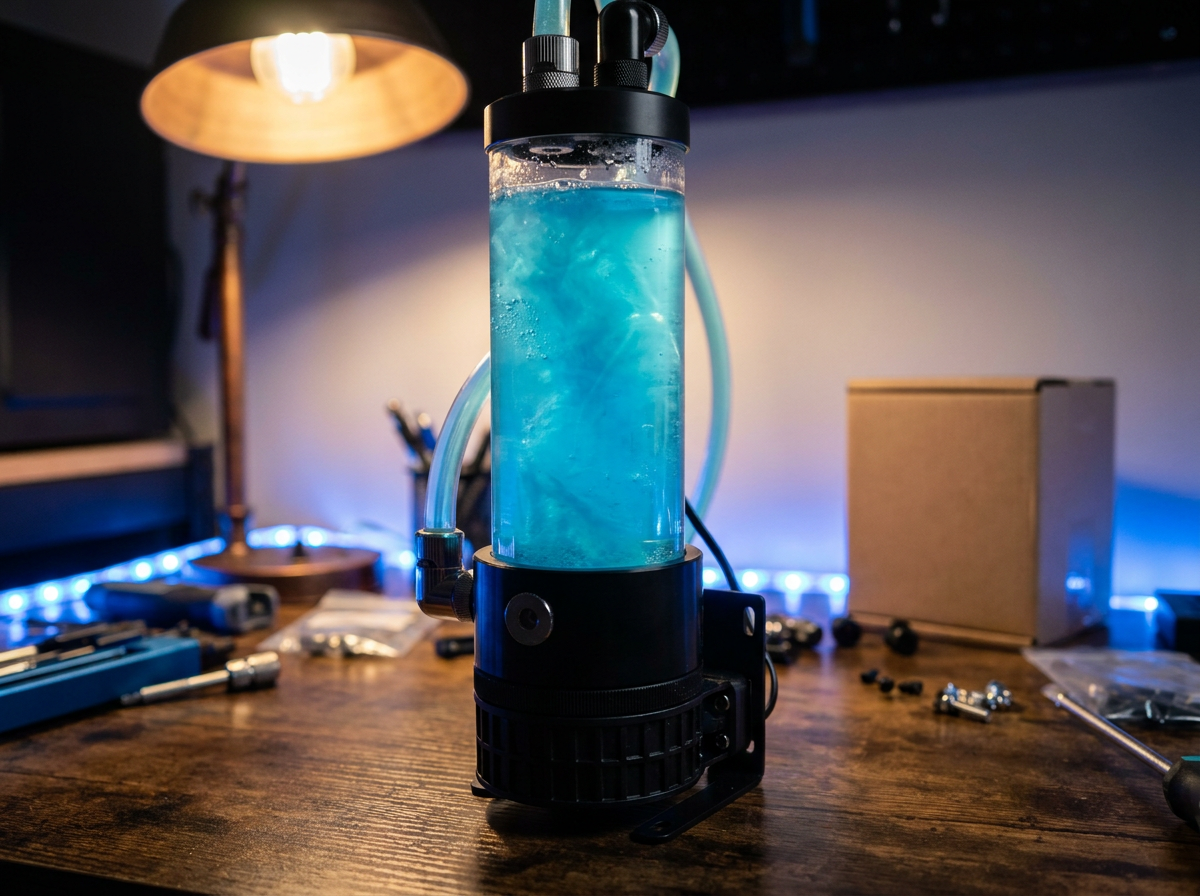
What makes it opaque
Conventional coloured coolants are dyes in solution, the colour is dissolved, so the fluid stays transparent and tinted. Vue is dyed too, but it also holds fine solid particles evenly through the fluid, and those are what make it opaque. White is the exception: particles with no dye. That is what gives it a flat, saturated, non-transparent colour instead of a stained-glass look.
A suspension only reads as solid while it stays suspended. Vue’s formulation is built to hold that particulate far longer than a conventional dyed fluid would, which is the whole engineering problem the product solves. It is also why the fluid is more sensitive to contamination than a clear coolant, anything that changes the chemistry changes how well the particulate stays put.
Why prep matters more with an opaque fluid
Machining oil, brazing flux and plasticiser all interfere with suspension. In a clear loop you might see a faint film and shrug. In an opaque loop the same contamination shows up as separation: colour pooling at the bottom of the reservoir, a thinner-looking fluid at the top, or streaking through the tubes.
This is the single most common cause of "my Vue separated." It is very rarely the fluid. It is almost always a loop that went together without a full prep, and the fluid is simply the first thing honest enough to show it.
UV response
Three colours in the Vue line are UV reactive. UV Green SX, UV NV Green and UV Green. The rest are not, and no amount of UV lighting will make them glow. Reactivity is a property of the specific formulation, not something you can add.
UV output does degrade the dye package over time in any fluid. If your build runs UV lighting continuously, treat that as a reason to inspect more often, not as a reason to avoid the colour.
How it ages
Day one to week two is the honest window. A loop that was prepped properly looks identical at week two. Any film, strand or colour shift this early is telling you the prep was incomplete, it is not the fluid degrading, because nothing degrades that fast.
After that, the first months should be uneventful. Expect some evaporation through soft tubing; top up with the same fluid, never with plain distilled, or you dilute the inhibitor and biocide package below spec.
Plan around six months, not twelve. Vue is a show coolant, not a daily driver, and it lasts as long as it lasts: pump hours, how well the loop was prepped, and how much air is out of the system decide it, not the calendar. When the colour starts thinning, settling or filming on the acrylic, drain it. Running past that is where you start trading a ninety-minute service for a teardown.
The three habits
One: prep completely, every time, including on parts that are brand new. Two: top up with the same fluid, never with water. Three: photograph the reservoir at fill so you have a reference for what "clear" looked like, memory is unreliable and colour drift is gradual.
System Reboot is the cleanser built for a loop that has run Vue. It lifts residue and pulls dye staining out of components without attacking nickel plating. Drain, run System Reboot per the bottle, rinse with distilled, then re-prep before refilling.
Next in fluids

Keeping It Cool is the technical library of PrimoChill. Products ship from primochill.com.
Guides
Fluids
© 2026 PrimoChill · Made in the U.S.A.