Reading a cloudy loop
A cloudy loop is a symptom, not a diagnosis. Three completely different failures produce a haze that looks the same through an acrylic reservoir, and each one has a different fix. Timing and texture are how you tell them apart.
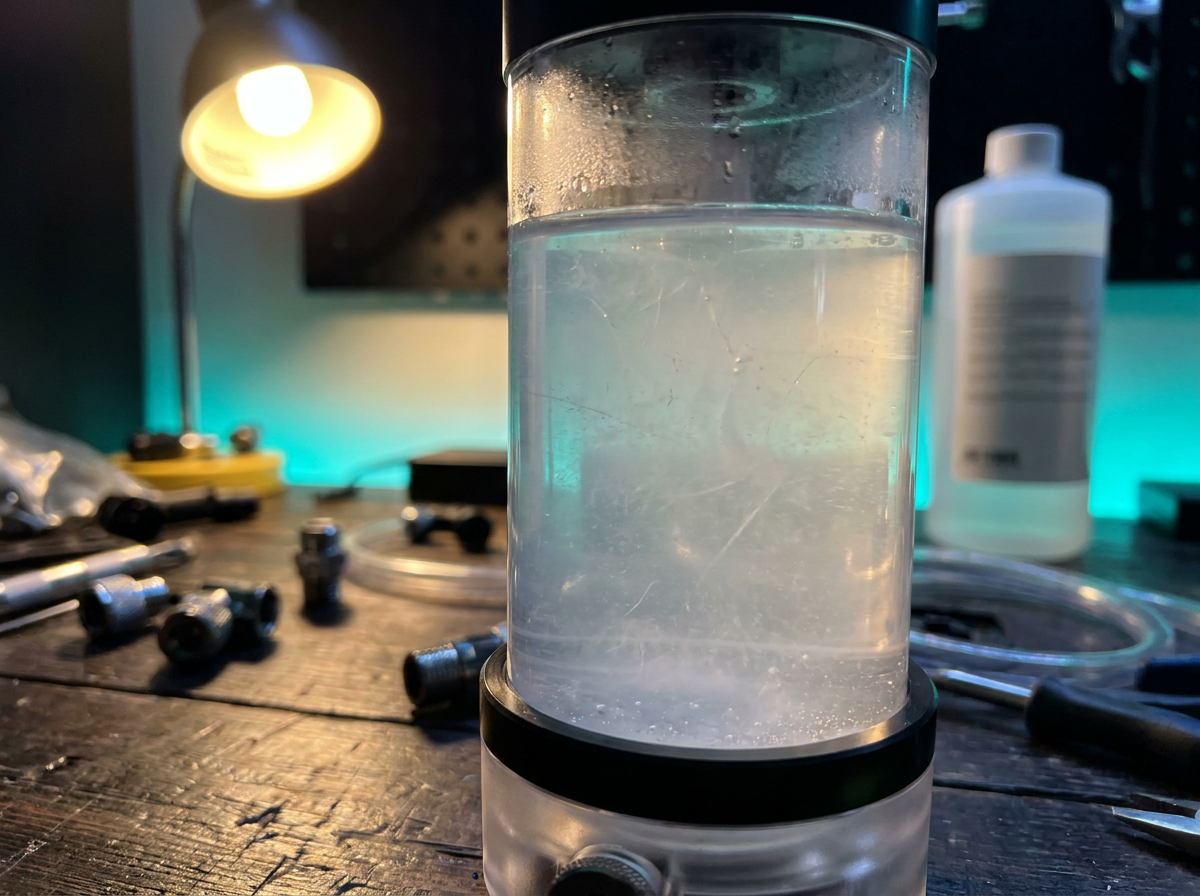
Start with when it happened
Timing narrows it faster than anything you can see. Clouding inside the first three weeks is almost never the fluid, nothing in a modern coolant degrades that fast. It is incomplete prep or a biological bloom.
Clouding at two to six months, in a loop with flexible tubing, is usually plasticiser. Clouding near the twelve-month mark on a loop that has never been serviced is simply the inhibitor package reaching the end of its rating.
Plasticizer leaching
Flexible tubing is a polymer plus additives that keep it flexible. Heat and time pull those additives out into the coolant, where they drop out of suspension as a white, waxy film on block fins and reservoir walls.
The tell is texture. Plasticiser deposits are greasy rather than granular, they favour the hottest parts of the loop, and if you drain the loop and run a finger inside a tube it feels slick. It is also the classic cause of "my clear fluid went milky," and it has nothing to do with the fluid you chose.
The fix is System Reboot to lift what has already deposited, and hardline or a better-quality flexible tubing if you want it to stop recurring.
Biological growth
A closed loop sitting at 35 °C is an incubator waiting for something to grow in it. Tap water provides that something. So does an un-gloved hand inside a reservoir, or a funnel that lived in a garage.
The tell is strands. Biological growth shows up as filaments or a haze with visible structure, it gets worse in the dark rather than better, and in an advanced case there is an odour when you open the loop. People routinely mistake early growth for dye separation.
The fix is a full drain, a SysPrep pass, and a refill using distilled or DI water only, plus the discipline of gloves and clean tools. A biocide package handles ordinary exposure; it does not handle an inoculum you introduce by the cupful.
Dye fallout
This is the one people assume first and encounter least. Genuine dye fallout means the colour package has come out of suspension, you see colour pooling at the bottom of the reservoir and a thinner, paler fluid above it, rather than a uniform haze.
In an opaque fluid like Vue, this is nearly always downstream of contamination rather than a fault in the fluid: machining oil or flux left in the loop interferes with the suspension. Which loops it back to prep.
What to do before you ask us
Photograph the reservoir under a torch against a white background. Note the fill date, the fluid, the tubing type, and every metal in the loop. Drain a sample into a clear glass and let it stand for an hour, separation, sediment and film all become obvious in still fluid in a way they never are in a moving loop.
That is four pieces of information and one photo, and it is usually enough for us to name the cause on the first reply.
At three weeks it is prep or biologicals. At three months with soft tubing it is plasticiser. At twelve months it is the service interval. The fluid itself is the least likely explanation in every one of those windows.
Next in maintenance

Keeping It Cool is the technical library of PrimoChill. Products ship from primochill.com.
Guides
Fluids
© 2026 PrimoChill · Made in the U.S.A.