Not sure which fluid you need?
Two questions, new build or existing loop and showcase or daily driver, and you get the fluid and the prep order.
Not sure which prep you need?
Two questions, what you are prepping and whether you want the kit, and you get the bottles in order with the dilution for each.
Every bottle has a place in the circuit.
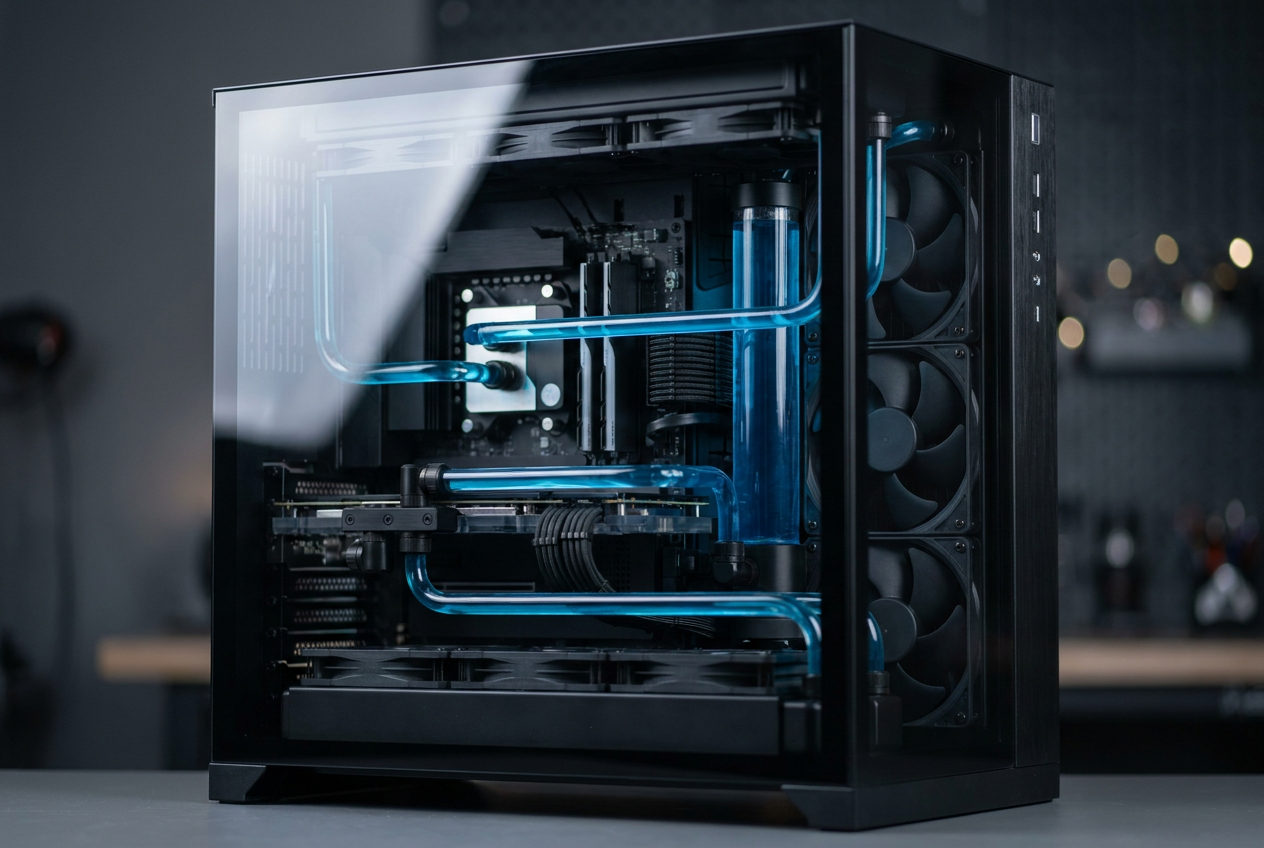
Coolant leaves the reservoir, passes through the blocks, sheds heat at the radiator and returns. Each prep treats a different part of that path, so the order matters.
The everyday whole-loop pre-treatment. 15 ml into one US gallon of DI or distilled water, circulated for 48 hours, then drained and rinsed. It clears what the blocks, tubing and fittings carry out of manufacturing so your coolant is not the thing cleaning them.
Nothing in this loop shipped clean.
Machining swarf in the block fins, flux and solder debris in the radiator, bending lubricant on the tube. Your coolant meets all of it on day one, and gets the blame when the loop clouds at week three.
A 0.25 mm fin channel does not need much to block. Open a new block and look before it ever sees fluid.
Sits in the tube ends from the factory. The number one source of blocked block fins in a first build.
Leaches out of clear flexible tube over weeks. This is the clouding people see at two to six months.
Handling oil and bending lube go straight into the coolant on day one unless the tube is wiped first.
Drain the first flush into a clear bucket and hold it against something white. That is what was about to go through your blocks.
Eight bottles. Four different forms.
Ready to use, concentrate, additive, base. Pick the form before the color: a concentrate needs a gallon of DI water, and an additive needs a gallon of DI water and adds no color.
Never built a loop before?
16 guides, from the first radiator flush to the annual service. Tools listed first, nothing assumed.
Send us a photo and a parts list.
We will tell you what the residue is and which bottle fixes it, usually within 48 hours.
Answered already
Keeping It Cool is the technical library of PrimoChill. Products ship from primochill.com.
Guides
Fluids
© 2026 PrimoChill · Made in the U.S.A.